
From AI for Science to Agentic Science: A Survey on Autonomous Scientific Discovery
The survey argues that "Agentic Science" - large language model (LLM) agents autonomously running the full hypothesis–experiment–analysis–refinement cycle - constitutes a distinct stage of AI for Science, and unifies the field through a three-layer framework of five foundational capabilities, four core processes, and four application domains.
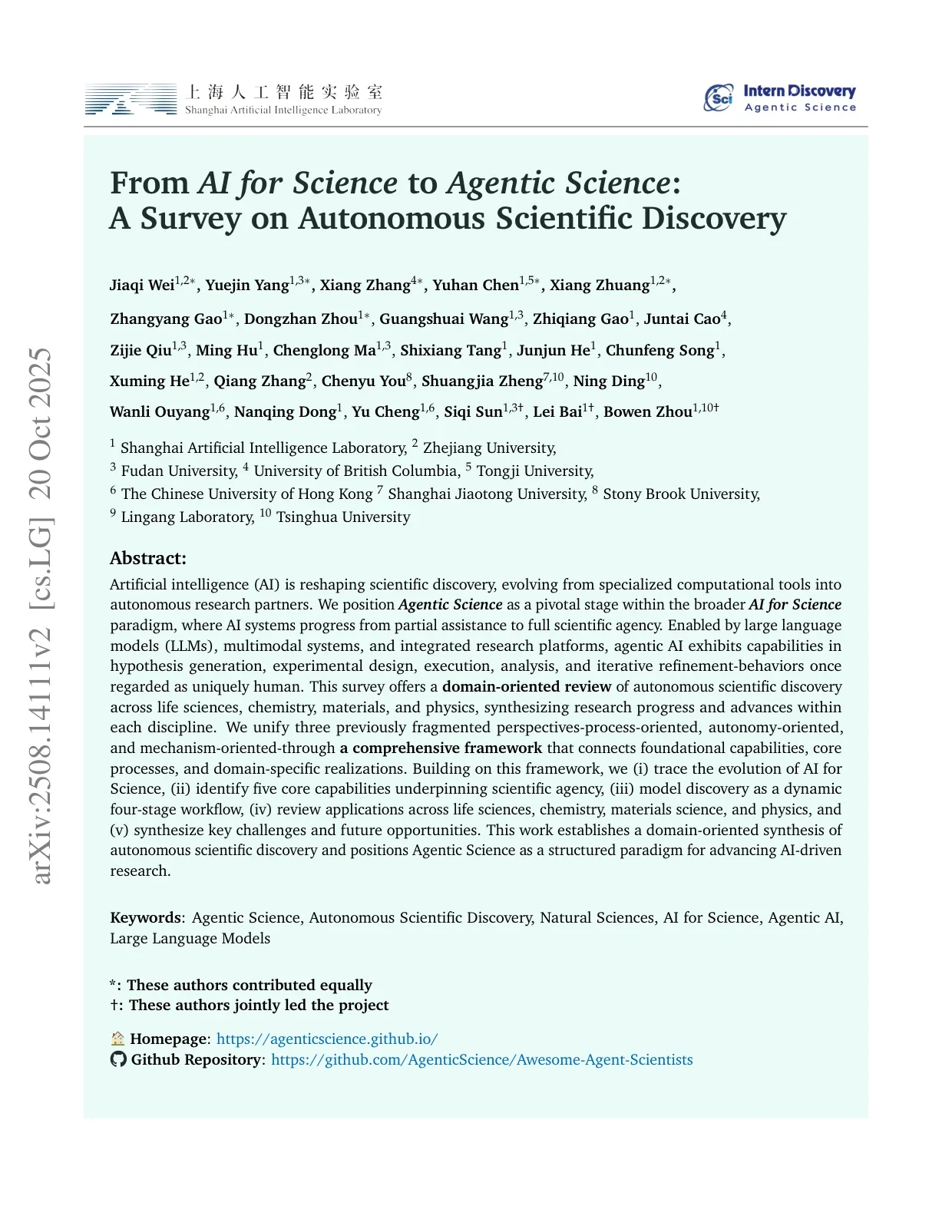
20 Oct 2025 · Paper
1. Motivation
AI for Science has progressed from static predictive models (“computational oracles”) to LLM-driven agents that plan, use tools, remember, collaborate, and self-improve. The authors contend that prior surveys are fragmented along three complementary axes - process-oriented (mapping LLM capabilities onto the research cycle), autonomy-oriented (grading systems by initiative), and mechanism-oriented (dissecting architectural primitives) - and treat workflows, autonomy scales, or architectures in isolation.1 The paper’s contribution is a comprehensive framework connecting foundational capabilities, core processes, and domain realizations, positioned at autonomy “Level 3 (Full Agentic Discovery) with precursors at Level 2 (Partial Agentic Discovery)”.1
2. Methodology
2.1 Search Structure
The survey itself documents no systematic literature-search protocol: no databases, date ranges, or inclusion/exclusion criteria are stated, so its corpus (a ~60-page document with roughly 455 references) is expert-curated and unauditable; the companion GitHub list “Awesome-Agent-Scientists” functions as the de facto corpus.2 At the field level, the survey formalizes planning and hypothesis generation as explicit search problems. Its capability layer (Section 3.1) organizes reasoning engines into: linear decomposition (plan-and-solve, zero-shot chain-of-thought); robust linear planning (self-consistency, majority voting, multi-agent debate); non-linear exploration with backtracking (Tree-of-Thought); lookahead search (Monte Carlo Tree Search / Upper Confidence bounds applied to Trees, MCTS/UCT, for “uncertainty and long horizons”); and dynamic thought–act–observe adaptation (ReAct).3 Hypothesis generation is cast as search over a candidate set:
with an explicit exploration–exploitation trade-off in a “vast, unstructured search space of possible hypotheses”.3
2.2 State Representation
The four-level autonomy scale (Section 2) gives increasingly rich state definitions, each with a formal equation: Level 1 is empirical-risk minimization over a static model class; Level 2 is a finite-horizon policy over a tool set given a human-set goal; Level 3 is an infinite-horizon policy maximizing discounted expected information gain over an evolving hypothesis set, where the agent state includes a knowledge base and experimental evidence , and the hypothesis set “itself can be modified by the agent’s actions”.3 The memory taxonomy (their Table 3) further differentiates state carriers: short-term/feedback memory (context windows, tool logs), episodic experience repositories (Reflexion4, ExpeL), reusable skill libraries (Voyager), and external knowledge hubs (retrieval-augmented generation (RAG), structured knowledge graphs, tiered MemGPT-style stores).3
2.3 Generation Mechanism
The survey is not generative itself; it catalogs how reviewed systems produce candidates. Hypothesis generation proceeds through knowledge ingestion (RAG over corpora; LitLLM, ResearchAgent), structuring literature into taxonomies and knowledge graphs, then “exploratory pattern discovery and symbolic reasoning” (SciAgents over structure–property relationships; MOOSE-Chem over chemical reactivity).3 Their Table 7 classifies fully-autonomous pipelines into five paradigms: foundational end-to-end frameworks (The AI Scientist5, NovelSeek, Dolphin6, X-Master); domain-specific automation (Coscientist, Biomni, AI co-scientist); multi-agent collaborative structures (VirSci, AgentRxiv7, MDAgents); self-evolving systems (STELLA, AlphaEvolve8); and human-in-the-loop designs (Agent Laboratory9).3
2.4 Evaluation & Grounding
Grounding mechanisms are organized in tiers: tool-based feedback as external validation (CRITIC validates and revises outputs via tools; Self Evolve debugs code from execution results); experimental and simulation tools as hypothesis validators (molecular docking, computational fluid dynamics, physics engines); and multi-agent debate emulating peer review for evidence synthesis.3 Benchmarks cited include SciCode and MLE-Bench for research coding, DiscoveryWorld as an evaluation environment, and ShortcutsBench for tool dependency.3 The analysis stage is framed as Bayesian belief updating, (their Eq. 7), and experimental planning as constrained optimization subject to (Eq. 6).3 Wet-lab grounding claims are reported secondhand: OriGene’s targets GPR160/ARG2 validated in patient-derived systems; Robin’s ripasudil hypothesis for diabetic macular edema.3
2.5 Memory / Information Flow
Memory is one of the five foundational capabilities (Section 3.3) and the survey’s most dedicated architectural treatment: memory “for iterative task execution” supports in-context adaptation, while memory “as a knowledge hub” connects agents to external repositories.3 Information flow in the four-process workflow (observation/hypothesis → planning/execution → analysis → synthesis/validation/evolution) is non-linear - “execution order may be dynamically adjusted” - and adaptive refinement updates the policy over trajectories of past (hypothesis, plan, result) tuples: (their Eq. 8).3 Named bottlenecks include knowledge decay (validating memory against superseded facts), multimodal heterogeneity, and long-horizon causal dependence on early experimental results.3
2.6 Selection & Propagation
The survey’s own selection criteria are unstated. Field-level selection mechanisms cataloged include self-consistency and debate for plan selection; MCTS “to optimize hypothesis selection over an entire research campaign”; population-based co-evolution, both cooperative (CAMEL, ProAgent) and competitive (debate, red-teaming), as propagation of improved strategies; and ensemble/consensus aggregation (MARG, MedAgents).3
2.7 Anti-Slop / Anti-Hallucination Mechanisms
Section 9 makes trustworthiness a first-class axis: (a) agentic reproducibility - unlike rerunnable code, “agentic discovery involves replicating a stochastic and context-sensitive discovery trajectory”, with planning execution accuracy reported “as low as 39%” on state-of-the-art benchmarks;3 (b) novelty validation - distinguishing a genuine conceptual leap from “sophisticated interpolation or hallucination”, which can produce fabricated findings, data, or references; (c) transparency - agents “interpretable by design” with structured internal logs; and (d) ethics, including dual-use risks. Remedies surveyed: provenance tracking of tool versions, parameters, and data lineage; automated reproducibility checks; formal verification of internal logic; and knowledge-graph consistency checking.3
3. Results
As a survey, its outputs are taxonomic rather than experimental: the four-level autonomy scale, the five-capability × four-process × four-domain framework, and extensive system tables. Empirical anchors quoted from reviewed systems include OriGene’s validated drug targets, Robin’s repurposing hypothesis, CellVoyager’s brain-aging link, and Virtual Lab’s nanobodies.3 Its positioning claim - that it subsumes three fragmented prior perspectives - is its main comparative result.1
4. Limitations & Assumptions
No corpus methodology means selection bias is unauditable; the autonomy levels and capability/process framework are the authors’ construction, and the formal equations are pedagogical formalisms, not validated models. Coverage leans heavily on 2024–2025 preprints, many unpeer-reviewed, and the lead institution’s own platforms (Intern-Discovery, Intern-S1) are promoted in the introduction. Level 4 (“Generative Architect”) and the proposed “Nobel-Turing Test” are explicitly speculative.3
5. Critical Analysis
- Distinctive strength: the most formal and most comprehensive of the recent agentic-science surveys - an explicit state/autonomy formalism plus a dedicated memory treatment that other surveys lack.
- Structural weakness / trade-off: breadth is bought with unauditable corpus construction and reliance on unreviewed preprints; its quantitative claims (e.g., the 39% execution accuracy) are inherited from cited benchmarks rather than re-run under matched conditions.
- Connections: it directly critiques and supersedes the autonomy taxonomy of Gridach et al. (paper 03 in this review) and subsumes the web-grounded pipeline of the Deep Research survey (paper 02); among reviewed systems it covers mission-list entries AlphaEvolve8 (paper 04) as a self-evolving exemplar, The AI Scientist5 (paper 09), Dolphin6 (paper 11), AgentRxiv7 (paper 14), and Agent Laboratory9 (paper 13), and builds its memory taxonomy on Reflexion4 (paper 21).
6. References
Footnotes
-
Wei et al., arXiv:2508.14111v2 HTML - https://arxiv.org/html/2508.14111v2 ↩ ↩2 ↩3
-
Awesome-Agent-Scientists companion repository - https://github.com/AgenticScience/Awesome-Agent-Scientists ↩
-
Wei et al., arXiv:2508.14111v2 PDF (full text) - https://arxiv.org/pdf/2508.14111v2.pdf ↩ ↩2 ↩3 ↩4 ↩5 ↩6 ↩7 ↩8 ↩9 ↩10 ↩11 ↩12 ↩13 ↩14 ↩15 ↩16 ↩17 ↩18
-
Shinn et al., Reflexion, arXiv:2303.11366 - https://arxiv.org/abs/2303.11366 ↩ ↩2
-
Lu et al., The AI Scientist, arXiv:2408.06292 - https://arxiv.org/abs/2408.06292 ↩ ↩2
-
Yuan et al., Dolphin, arXiv:2501.03916 - https://arxiv.org/abs/2501.03916 ↩ ↩2
-
Schmidgall et al., AgentRxiv, arXiv:2503.18102 - https://arxiv.org/abs/2503.18102 ↩ ↩2
-
Novikov et al., AlphaEvolve, arXiv:2506.13131 - https://arxiv.org/abs/2506.13131 ↩ ↩2
-
Schmidgall et al., Agent Laboratory, arXiv:2501.09727 - https://arxiv.org/abs/2501.09727 ↩ ↩2