
MLEvolve: A Self-Evolving Framework for Automated Machine Learning Algorithm Discovery
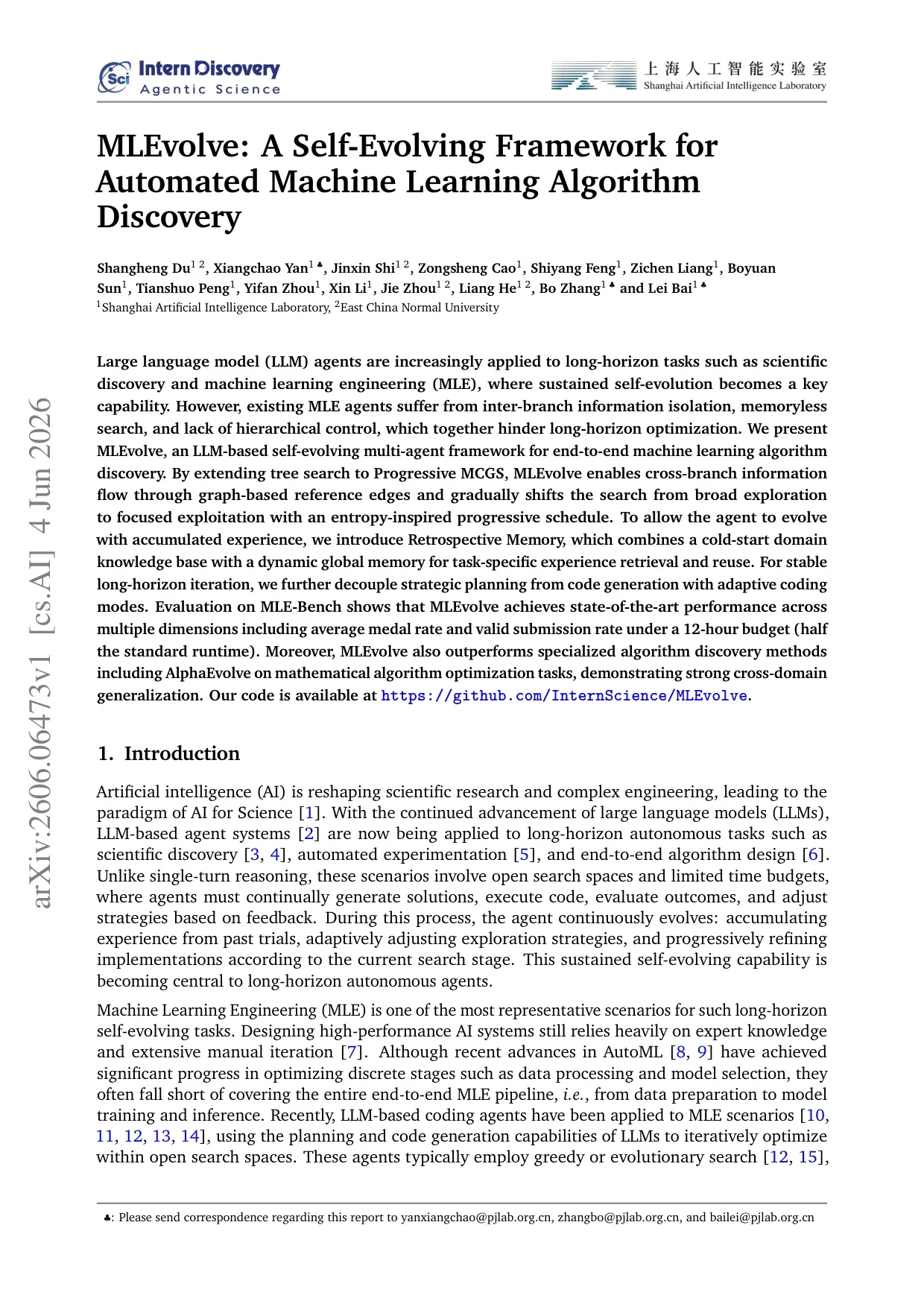
A self-evolving multi-agent framework that repairs three failure modes of MLE agents - inter-branch information isolation, memoryless search, and one-shot generation - via Progressive Monte Carlo Graph Search, Retrospective Memory, and Hierarchical Planning with Adaptive Code Generation, reaching a 65.3% medal rate on MLE-Bench at half the standard budget (12 h vs. 24 h) and the best result on 11 of 15 AlphaEvolve math tasks.
2026 · Paper
1. Motivation
Agents for automated machine learning (MLE agents) - from AIDE’s greedy tree to MCTS-based systems - suffer three structural defects: branches of the search cannot share what they learn (information isolation), each run starts from scratch (memoryless search), and code is produced in a single pass with no staged refinement (one-shot generation).1 MLEvolve replaces the tree with a graph and adds an experience substrate, aiming to transfer the AlphaEvolve-style evolutionary-discovery recipe to full Kaggle-grade ML pipelines while remaining general enough to beat specialized algorithm-discovery systems on their own math benchmarks.12
2. Methodology
2.1 Search Structure
The search space is a directed graph with (Eq. 2). Primary edges encode parent→child generation and carry selection and credit assignment; reference edges connect nodes across branches and levels for information reuse but are excluded from backpropagation. When , the search reduces to standard MCTS.2 The loop follows MCTS phases - selection, expansion, simulation, backpropagation - under a progressive exploration schedule designed so the Shannon entropy of branch selection decreases over time: UCT with a time-decaying exploration constant annealed from to (Eq. 3), plus a soft strategy switch
with decaying from 1.0 to (Eq. 4). Elite-Guided exploitation samples from a global top- set weighted by inverse rank (Eq. 5). Empirically, effective active branches decay from 4.8 to 2.8, versus roughly uniform for vanilla MCTS.2
2.2 State Representation
Each node is a complete candidate ML solution - preprocessing, feature engineering, model training, prediction - formalized as (Eq. 1).2 Node records carry plan, code, metrics, analysis, and feedback; lifecycle states are Draft / Improve / Debug / Evolution / Fusion / Aggregation, plus Top/Best markers.2
2.3 Generation Mechanism
Generation is planner–coder decoupled. The planner decides what to modify and why, at module level, using execution feedback, branch trajectories, and retrieved memory; the coder implements how in one of three adaptive modes: Base (full rewrite from scratch, for initial drafting), Stepwise (module-by-module following the planner spec), and Diff (targeted patches for localized refinement).2 Four expansion operators instantiate (Eq. 6), differing in the retrieved context :
- Primary expansion: .
- Intra-branch evolution: = nearest ancestors in the same branch.
- Cross-branch reference: = top- nodes across branches, triggered by branch stagnation.
- Multi-branch aggregation: = top trajectories merged into a new branch root, triggered by global stagnation.
These are implemented by nine specialized agents (Draft, Improve, Debug, Evolution, Fusion, Aggregation, Code Review, Data Leakage, Result Parse), backed by Gemini-3.1-Pro-preview at temperature 1.0.2
2.4 Evaluation & Grounding
The simulation step executes candidate code in an interpreter and parses outputs for the task metric. A shaped immediate reward (Eq. 7) assigns for execution failure or no valid metric, for success without branch-best improvement, and for refreshing the branch best.2 MLE-Bench scoring uses Kaggle medal thresholds over 75 competitions; the 15 math tasks reuse AlphaEvolve’s evaluators.2
2.5 Memory / Information Flow
Retrospective Memory combines (a) a static, manually curated domain knowledge base (candidate models + usage guidelines per task type, retrieved by keyword matching, Eq. 10) for cold start, and (b) a dynamic global memory accumulating structured records (plan, outcome, analysis, feedback) after each valid execution.2 Retrieval is hybrid: BM25 lexical scoring plus FAISS semantic search over BGE-base-en-v1.5 embeddings, fused by Reciprocal Rank Fusion (Eq. 11). Retrieval is stage-aware - successful/failed experiences refine plans at planning time, and the error message becomes the query during debugging. The claimed differentiator is that experience accumulates “without requiring additional LLMs for explicit reflection.”2
2.6 Selection & Propagation
Selection is UCT on the tree backbone only; rewards backpropagate along only: , , (Eqs. 8–9).2 Multi-level stagnation control drives propagation: after consecutive non-improving expansions, intra-branch evolution (later cross-branch reference) fires; after steps without global-best improvement, multi-branch aggregation merges top trajectories. The final submission is an ensemble of graph-level top- nodes.2
2.7 Anti-Slop / Anti-Hallucination Mechanisms
A Code Review Agent screens every generated program for naming/import errors, suspicious patterns, and metric consistency before execution. A Data Leakage Agent “checks for potential leakage between training and evaluation splits to prevent overfitting to evaluation artifacts and avoid inflated scores.” A Debug Agent repairs failures from error traces with minimal modifications up to a retry limit, and the failure reward prevents unverifiable proposals from accruing credit; the Result Parse Agent structures logs back into the loop.2
3. Results
- MLE-Bench (75 tasks, mean ± SEM over 3 seeds): 65.3% overall medal rate (80.3 low / 64.0 medium / 46.7 high complexity), 100% valid submissions, 76.0% above-median, 34.7% gold - under a 12 h budget. Baselines (24 h unless noted): AIBuildAI (Claude-Opus-4.6) 63.1%; MARS+ 62.7%; ML-Master 2.0 56.4%; R&D-Agent (GPT-5) 35.1%; AIRA-Dojo (o3) 31.6%; AIDE (o1-preview) 17.1%.2 Budget: max 500 expansion steps, 21 vCPUs, 234 GB RAM, 1× H200 per task.2
- Math generalization (15 AlphaEvolve tasks): best on 11/15 vs. AlphaEvolve,3 AlphaEvolve-v2,4 SimpleTES, TTT-Discover, and OpenEvolve5 - e.g., first autocorrelation inequality 1.5028628749 vs. OpenEvolve’s 1.5028628983 and AlphaEvolve’s 1.5052939684; circle packing 2.6359830395 vs. AlphaEvolve’s 2.6358627564.2
- Ablations (MLE-Bench Lite, 22 tasks): removing Progressive MCGS drops medals 81.82%→68.18% (largest drop); removing Retrospective Memory 81.82%→68.18%; removing Adaptive Code Generation →72.73%. Mechanism-level: removing intra-branch evolution collapses medals 66.67%→33.33%.2
Baseline numbers are partly taken “from the MLE-Bench leaderboard or the corresponding papers,” not re-run under matched conditions.2
4. Limitations & Assumptions
Reward shaping is task-metric-specific; the static knowledge base is manually curated; math-task comparisons reuse AlphaEvolve evaluators across methods with different LLM backbones and budgets (not compute-matched).2 Exact stagnation thresholds and schedule constants () live in an appendix whose values were not audited here; the arXiv HTML rendering is truncated after §4.2 (the PDF is authoritative). The 2026-dated tables reference very recent models (Gemini-3.1-Pro-preview, GPT-5.5), so benchmark-leakage and comparability caveats apply.
5. Critical Analysis
- Distinctive strength: reference edges with no credit assignment are a clean formal solution to cross-branch information flow - transfer without contaminating UCT statistics - and the entropy-decay schedule makes the exploration→exploitation shift measurable rather than anecdotal.2
- Structural weakness / trade-off: the architecture is heavy - nine agents, a curated knowledge base, an embedding index, shaped rewards with per-task bounds - and the strongest ablated component (intra-branch evolution, halving medals when removed) is a conventional within-branch refinement loop, so how much of the gain is attributable to the graph machinery itself remains open.
- Connections: MLEvolve benchmarks directly against AlphaEvolve (#4) and AlphaEvolve-v2 on their own 15 math tasks and against OpenEvolve (#7) as a named baseline.2 Its MLE-Bench protocol and medal metric connect it to Theme-4 systems - AIDE (#15) (17.1%) and MARS (#17) (MARS+ 62.7%) - which it surpasses at half the runtime.2 Conceptually it is the graph-search counterpoint to the archive-of-programs design of FunSearch (#6).
6. References
Footnotes
-
Du et al., “MLEvolve: A Self-Evolving Framework for Automated Machine Learning Algorithm Discovery,” arXiv:2606.06473 - https://arxiv.org/abs/2606.06473 ↩ ↩2
-
MLEvolve full text (PDF; arXiv HTML is truncated after §4.2) - https://arxiv.org/pdf/2606.06473 ; code: https://github.com/InternScience/MLEvolve ↩ ↩2 ↩3 ↩4 ↩5 ↩6 ↩7 ↩8 ↩9 ↩10 ↩11 ↩12 ↩13 ↩14 ↩15 ↩16 ↩17 ↩18 ↩19 ↩20 ↩21 ↩22 ↩23
-
Novikov et al., “AlphaEvolve: A coding agent for scientific and algorithmic discovery,” arXiv:2506.13131 - https://arxiv.org/abs/2506.13131 ↩
-
Georgiev, Gómez-Serrano, Tao & Wagner, “Mathematical exploration and discovery at scale,” arXiv:2511.02864 - https://arxiv.org/abs/2511.02864 ↩
-
OpenEvolve repository - https://github.com/algorithmicsuperintelligence/openevolve ↩