
GigaEvo, ShinkaEvolve, and ThetaEvolve: Efficiency-Focused Derivatives of AlphaEvolve
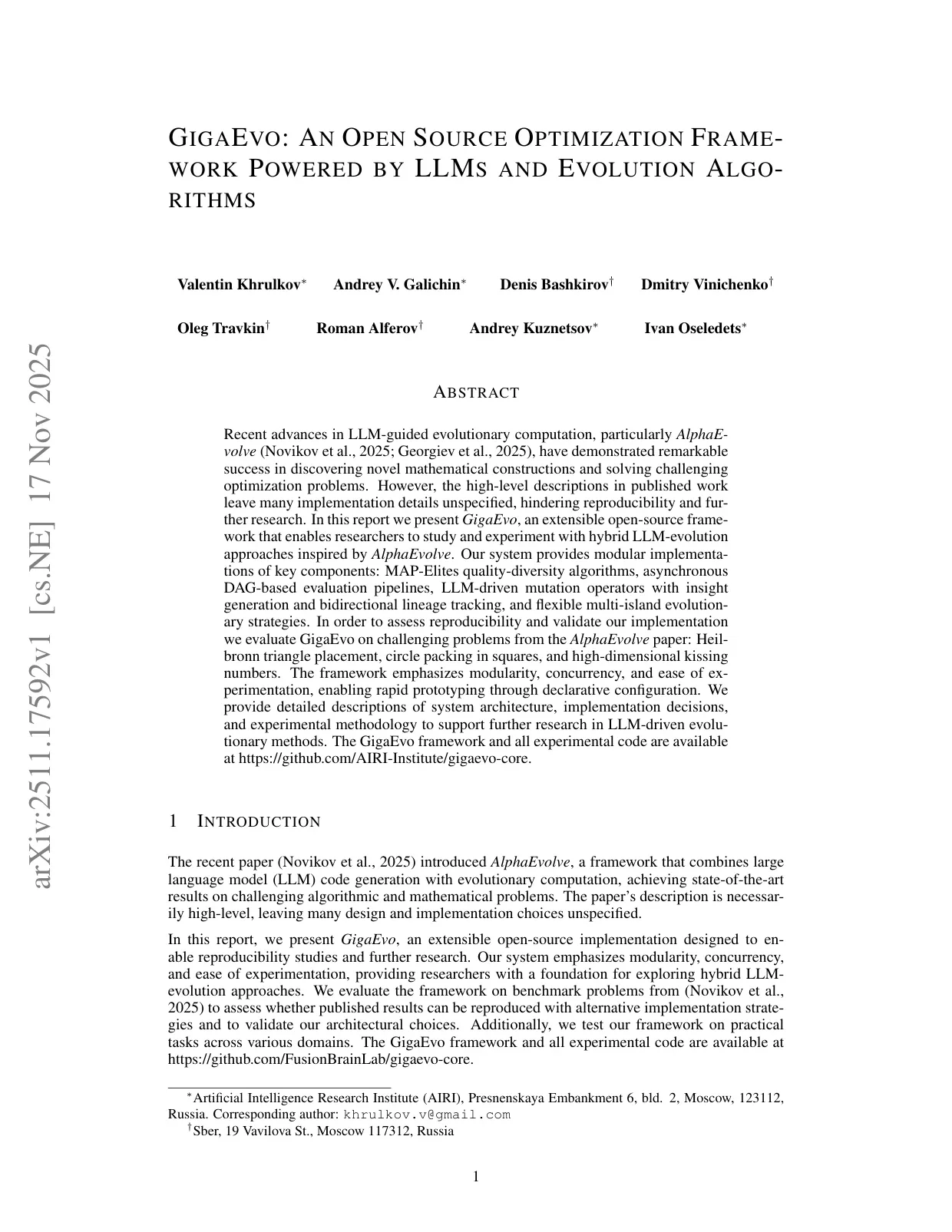
Three independent open-source derivatives show that AlphaEvolve-style program evolution can be made reproducible and radically more sample-efficient - GigaEvo by engineering the unspecified infrastructure, ShinkaEvolve by principled parent/LLM selection (new circle-packing SOTA in 150 samples), and ThetaEvolve by batch generation plus test-time RL (new best-known bounds from a single 8B open model).
2025 · GigaEvo · ShinkaEvolve · ThetaEvolve
1. Motivation
AlphaEvolve demonstrated frontier results but disclosed neither its database dynamics nor budgets, and its ~thousand-sample, ~100-compute-hour-per-candidate regime is out of reach for most labs.1 These three systems attack complementary bottlenecks: GigaEvo re-implements the missing machinery as a validated open framework;2 ShinkaEvolve asks how few samples suffice if selection and mutation are principled;3 ThetaEvolve asks whether a small open model can reach AlphaEvolve-level results when test-time compute is scaled via batch inference and the model is trained by RL during the run.4
2. Methodology
2.1 Search Structure
GigaEvo: four components - a Redis database of Program units (UUID, source, lifecycle state, metrics, genealogical lineage) with optimistic concurrency control; an asyncio DAG execution engine (execution → validation → complexity analysis → LLM inference); an evolution engine implementing MAP-Elites over fitness × validity behavior cells, single- or multi-island with periodic migration; and a LangGraph mutation agent.2 ShinkaEvolve: a fixed-size archive of island subpopulations in a three-phase loop - (1) parent + inspiration sampling, (2) LLM mutation with novelty rejection, (3) execution + world feedback updating LLM-ensemble probabilities and a meta-scratchpad; islands evolve in parallel with occasional migration, but “we prevent the island-specific best-performing program from migrating” (following FunSearch/Tanese).35 ThetaEvolve: a deliberately simplified loop built on OpenEvolve as the dynamic environment - one large program database ranked by score/diversity with eviction (MAP-Elites-style variants ablated), optionally wired into RL training (GRPO, asymmetric clipping 0.2/0.28, no KL regularization).46
2.2 State Representation
All three evolve whole programs with AlphaEvolve-style EVOLVE-BLOCK-START/END mutable regions (ShinkaEvolve programmatically protects immutable code).234 GigaEvo defines a problem as a directory - task_description.txt, declarative metrics.yaml (direction, discretization bounds, significance thresholds), validate.py, initial_programs/ - making tasks versioned artifacts.2
2.3 Generation Mechanism
GigaEvo’s LangGraph agent composes prompts from task description, parent code, metrics, generated insights, and lineage analyses, with multi-model routing (different models for insight generation vs. mutation) and both diff and rewrite modes; a key empirical finding: “many open-source models struggle to reliably produce syntactically correct diffs … the rewrite strategy produces robust, syntactically valid programs with low failure rates.”2 ShinkaEvolve offers three mutation modes - AlphaEvolve-style SEARCH/REPLACE diffs, full rewrites with guaranteed immutable-block preservation, and explicit crossover (a second archive program is sampled and the LLM combines them; dedicated prompts_cross.py) - with invalid patches resampled via Reflexion parsing feedback; model and temperature are drawn per-mutation from a multi-provider pool.36 ThetaEvolve uses a single LLM with prompts containing optionally only the parent, but generates in batches: parents × responses (temperature 1.0) per step, sized to saturate vLLM/SGLang batched inference, which AlphaEvolve’s single-prompt async pipeline cannot exploit.4
2.4 Evaluation & Grounding
GigaEvo: DAG ordering enforces metrics-before-insights; kissing-number validation uses exact integer arithmetic (arbitrary-precision squared norms, exhaustive pairwise distance checks).2 ShinkaEvolve: multi-objective assessment per program - scalar fitness, public metrics, and textual feedback, all archived and rendered into future prompts.3 ThetaEvolve: manually designed “unhackable evaluators”; for RL, rewards are shaped as with , mapping task bounds (), because raw objective ranges (e.g., 0.90–0.96) cannot differentiate candidates.4
2.5 Memory / Information Flow
GigaEvo adds two analysis layers: per-program insights (LLM-categorized by type, effect, severity) and bidirectional lineage tracking - how a program improved over ancestors and how descendants improved over it - aggregated into mutation prompts.2 ShinkaEvolve stores textual feedback per program and runs a meta-scratchpad: every generations a meta-agent distills recent evaluations into strategies and recommendations appended to mutation prompts.3 ThetaEvolve keeps the database as sole in-run memory, but the RL checkpoint itself becomes cross-task memory - trained checkpoints progress faster on unseen tasks.4
2.6 Selection & Propagation
GigaEvo: fitness-proportional elite selection within MAP-Elites cells; multi-island = independent archives with periodic migration of top programs.2 ShinkaEvolve introduces two parent-selection rules - power-law sampling over fitness ranks, and weighted sampling with sigmoid performance and offspring-count novelty - plus a UCB1 bandit over the LLM ensemble, where each LLM’s reward is the relative improvement against baseline , promoting “bold, high-risk, high-reward mutations.”3 ThetaEvolve: database ranking with eviction and OpenEvolve-inherited parent sampling.4
2.7 Anti-Slop / Anti-Hallucination Mechanisms
GigaEvo: rewrite-mode robustness, significance thresholds, exact-integer validation, error traces captured into insight generation.2 ShinkaEvolve: code-novelty rejection sampling - embed mutable code, compute cosine similarity within the island, and if max similarity exceeds , query an LLM-as-novelty-judge; near-duplicates are never evaluated - plus immutable-block enforcement.3 ThetaEvolve: an early check rejecting responses missing SEARCH/REPLACE blocks; a lazy penalty discarding children equivalent (up to comment removal) to any program already in the database, stopping the model from repeating the current best program near best-known scores; and evaluator-integrity fixes - it documents OpenEvolve’s 1e-6 circle-overlap tolerance (reporting strict results that survive radius shrinkage) and corrects “several typos” in AlphaEvolve’s ThirdAutoCorrIneq verifier.4
3. Results
- GigaEvo approximately reproduces AlphaEvolve: Heilbronn triangles () 0.0364 vs. 0.0365; circle packing 2.63598, 2.939 vs. prior SOTA 2.937; kissing reached the known bound 840 without improvement (authors speculate training-data contamination); FunSearch bin-packing SOTA replicated in ~200 LLM calls (Llama-3 7B + 70B, temperature 0.6).2
- ShinkaEvolve sets a circle-packing () SOTA of ≈2.635983 in 150 samples; +~2.3% average over ALE-Agent on ALE-Bench LITE (ahc039 would rank 2nd on AtCoder); an evolved MoE load-balancing loss (30 training iterations) transfers to a 2.7B-parameter model, beating global-batch LBL on perplexity and 7 downstream benchmarks. Ablations: weighted parent sampling > hill-climbing; bandit ensemble > fixed ensemble > single LLM; embedding rejection ≫ no rejection.3
- ThetaEvolve: with one DeepSeek-R1-0528-Qwen3-8B model, new best-known bounds - circle packing 2.63598308 (vs. ShinkaEvolve 2.63598283, AlphaEvolve 2.63586276) and first autocorrelation inequality 1.503133 (vs. AlphaEvolve 1.503164); its discovered program finds the configuration in ~3 s vs. ~75 s for ShinkaEvolve’s six-frontier-model program; RL-at-test-time beats inference-only across four tasks and transfers to unseen tasks.4
These numbers come from each paper’s own evaluators; tolerances and budgets differ (ThetaEvolve itself flags the tolerance issue), so cross-system comparisons are approximate.4
4. Limitations & Assumptions
GigaEvo found “no clear benefit of multi-island MAP-Elites,” and its report is not peer-reviewed.2 ShinkaEvolve’s AIME gains are partly attributed by its own authors to training-data contamination, and dollar costs are figure-only.3 ThetaEvolve needs per-task reward-shaping bounds and its RL cost is unquantified.4 All three inherit the AlphaEvolve premise: a hand-built, machine-checkable evaluator per task.
5. Critical Analysis
- Distinctive strength: collectively they turn AlphaEvolve from an unreproducible white paper into an engineering science - ShinkaEvolve’s 150-sample SOTA shows selection/bandit/novelty mechanisms dominate raw sampling scale,3 and ThetaEvolve shows the loop itself is a trainable RL environment.4
- Structural weakness / trade-off: all three validate mostly on the same small suite of AlphaEvolve math tasks (circle packing, autocorrelation, kissing numbers), risking benchmark fixation; and their evaluation protocols are not mutually calibrated, as ThetaEvolve’s tolerance findings demonstrate.4
- Connections: all three are derivatives of AlphaEvolve (#4) and inherit FunSearch (#6)-style island migration (ShinkaEvolve cites it directly; GigaEvo replicates its bin-packing result).235 ThetaEvolve is built on OpenEvolve (#7) code,46 while ShinkaEvolve’s explicit crossover is the documented contrast with OpenEvolve’s inspirations-only design;6 all three appear in MLEvolve (#5)‘s comparative tables, and their archives instantiate MAP-Elites (#25).7
6. References
Footnotes
-
Novikov et al., “AlphaEvolve: A coding agent for scientific and algorithmic discovery,” arXiv:2506.13131 - https://arxiv.org/abs/2506.13131 ↩
-
Khrulkov et al., “GigaEvo: An Open Source Optimization Framework Powered by LLMs and Evolution Algorithms,” arXiv:2511.17592 - https://arxiv.org/abs/2511.17592 ; code: https://github.com/AIRI-Institute/gigaevo-core ↩ ↩2 ↩3 ↩4 ↩5 ↩6 ↩7 ↩8 ↩9 ↩10 ↩11 ↩12
-
Lange, Imajuku & Cetin, “ShinkaEvolve: Towards Open-Ended and Sample-Efficient Program Evolution,” arXiv:2509.19349 - https://arxiv.org/abs/2509.19349 ; code: https://github.com/SakanaAI/ShinkaEvolve ↩ ↩2 ↩3 ↩4 ↩5 ↩6 ↩7 ↩8 ↩9 ↩10 ↩11 ↩12
-
Wang et al., “ThetaEvolve: Test-time Learning on Open Problems,” arXiv:2511.23473 - https://arxiv.org/abs/2511.23473 ; code: https://github.com/ypwang61/ThetaEvolve ↩ ↩2 ↩3 ↩4 ↩5 ↩6 ↩7 ↩8 ↩9 ↩10 ↩11 ↩12 ↩13 ↩14
-
Romera-Paredes et al., “Mathematical discoveries from program search with large language models,” Nature 625:468–475 - https://www.nature.com/articles/s41586-023-06924-6 ↩ ↩2
-
OpenEvolve repository and Discussion #412 (crossover contrast) - https://github.com/algorithmicsuperintelligence/openevolve ; https://github.com/algorithmicsuperintelligence/openevolve/discussions/412 ↩ ↩2 ↩3 ↩4
-
Du et al., “MLEvolve,” arXiv:2606.06473 - https://arxiv.org/abs/2606.06473 ; Mouret & Clune, “MAP-Elites,” arXiv:1504.04909 - https://arxiv.org/abs/1504.04909 ↩