
MARS / MARS+: Modular Agent with Reflective Search for Automated AI Research
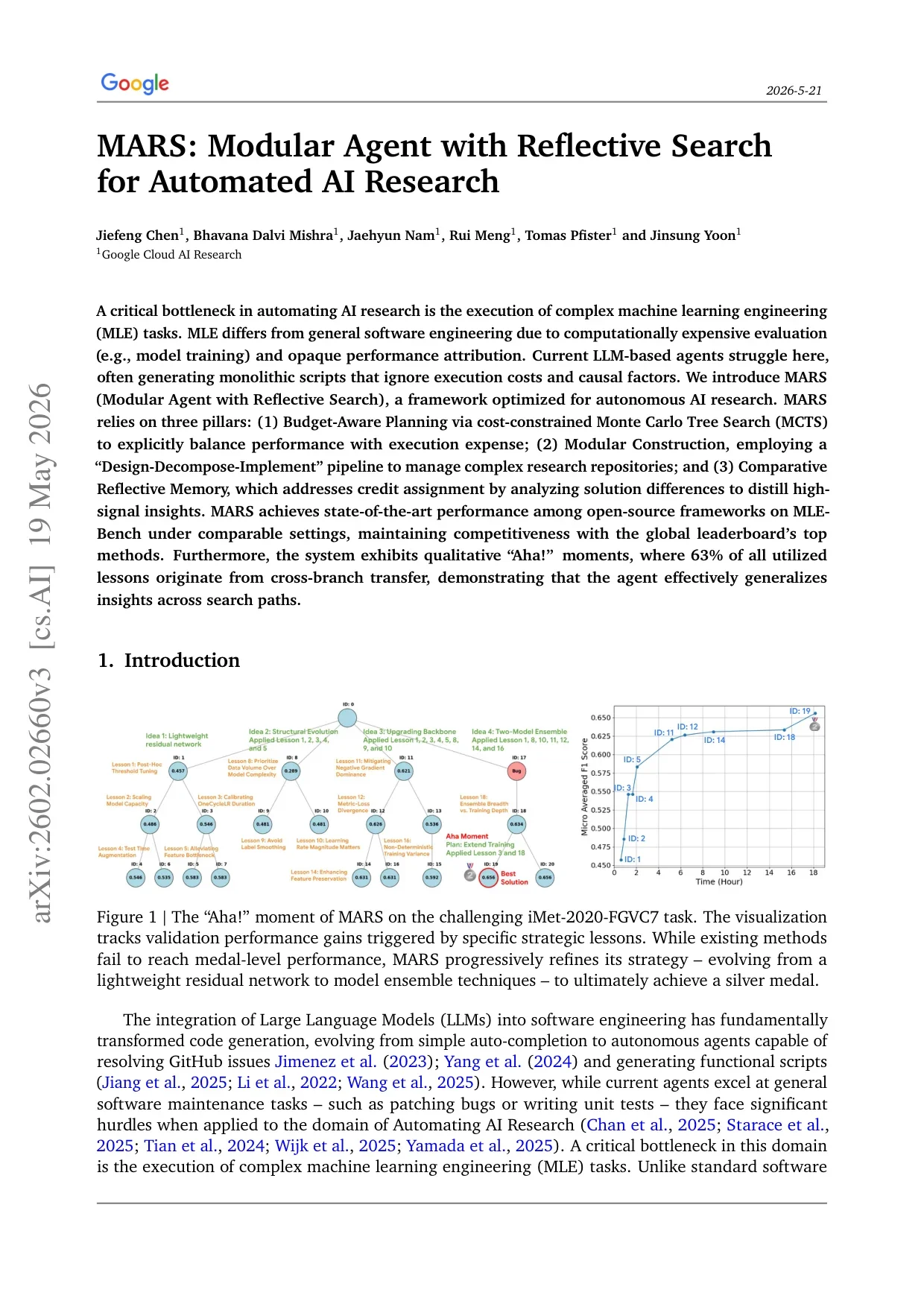
MARS treats automated AI research as cost-constrained search over a space of whole software repositories, combining budget-aware MCTS with an efficiency-shaped reward, a Design-Decompose-Implement modular construction pipeline, and a comparative reflective memory whose lessons are distilled from diffs against the previous best solution.
19 May 2026 · Paper
1. Motivation
Machine learning engineering (MLE) differs from general software engineering in two ways that break naive agent loops: evaluation is computationally expensive (each candidate requires training), and performance attribution is opaque (it is hard to say which edit caused a metric shift).1 Greedy agents such as AIDE ignore both issues - they select the best node without accounting for evaluation cost and summarize history without isolating causes.2 MARS therefore formalizes the problem as subject to , and designs every mechanism - reward, memory, state granularity - around cost-awareness and causal attribution.1 MARS+ is not a separate paper: it appears only in v3 as “a variant configured to execute two concurrent search trees with increased compute (2×H100 GPUs and 48 vCPUs).”1
2. Methodology
2.1 Search Structure
Budget-aware Monte Carlo Tree Search with the standard four phases over a tree whose nodes are entire software repositories, not single scripts. (The “simulation” of an executed ML pipeline is simply the real evaluation - there is no learned rollout policy.) One iteration runs:
Selection:    descend by UCT until a not-fully-expanded node
Expansion:    Draft / Improve / Debug child via specialized agents
Simulation:   execute the repository; score with efficiency-guided reward
Backprop:     propagate reward along the path; update visit statistics
A root re-activation rule restarts drafting when traversal bottoms out at a fully-expanded leaf, so the tree keeps acquiring new lineages instead of stalling.1
2.2 State Representation
A problem is a tuple (Instruction, Environment, Objective). Each node state is a modular multi-file repository plus score, execution cost, and defect status. Fully-expanded bookkeeping: buggy nodes are always fully expanded; valid nodes after improve-children; the root unless it is childless or the best solution has not improved after valid nodes.1
2.3 Generation Mechanism
A “Design-Decompose-Implement” pipeline with three specialized agents:1
Idea agent    -> proposes a research direction
Modular agent -> architects it into independent, testable modules
Coding agent  -> implements the modules + main script
Updates use Diff-Based Refinement - specific logic blocks are patched without regenerating the whole codebase. Expansion operators: Drafting (root expansion, new solution from scratch), Improvement (modify modules + main script of a valid node), Debugging (inherit structure, fix failing modules; buggy children enter an automatic debug loop of up to actions).1
2.4 Evaluation & Grounding
Efficiency-Guided Reward. Let be the min–max-normalized validation metric over explored history (0.5 if ). Then
where is execution time, the time limit, and the penalty weight follows Tan et al.13 Two candidates with equal accuracy but different runtime therefore receive different rewards - the reward, not the selection rule, carries budget awareness. Task preparation uses a multi-agent metadata extractor plus an EDA agent whose prompt mandates “Ensure all analysis is strictly performed on the training set to prevent data leakage.”1
2.5 Memory / Information Flow
The memory object is a Comparative Reflective Memory: a bounded pool of structured, causally attributed lessons. For each valid solution, a two-stage distillation runs: an Empirical Analysis Agent extracts objective findings from logs, then a Lesson Distillation Agent performs comparative reflection on the delta between the current solution and the previous best-known solution, emitting structured lessons: (1) the isolated causal change, (2) comparative impact analysis, (3) a generalized rule. Failures get a dedicated debugging-lesson agent (fix efficacy, failure logic, preemptive guidelines). A Review Agent filters redundancy; the most recent lessons stay in context, and the agent must explicitly cite lessons when applying them.1
2.6 Selection & Propagation
Standard UCT child selection descends until a not-fully-expanded node; the efficiency-shaped reward is backpropagated along the path. Budget-awareness thus enters through the reward signal rather than a modified selection formula - a deliberately simple budget controller. MARS+ scales this by running two concurrent search trees (2×H100, 48 vCPUs).1
2.7 Anti-Slop / Anti-Hallucination Mechanisms
(a) Comparative delta analysis grounds lessons in concrete code diffs, mitigating misattribution; (b) a lesson audit: Claude 4.6 Sonnet audited all 3,611 solution lessons generated by Gemini-3-Pro-Preview - 88.34% correctly attributed metric shifts to specific code changes “rather than relying on hallucinated narratives,” with a manual 20-lesson check giving 90% causal accuracy; (c) mandatory lesson citation; (d) anti-leakage EDA prompt rules; (e) modular testability replacing fragile monoliths.1
3. Results
Controlled environment (1×A100-40GB, 12 vCPUs, 220 GB RAM; no warm-up; baselines re-run identically; mean ± SEM, 3 runs, 24-h limit) on MLE-Bench:1
| Agent (model) | Valid | Above med. | Gold | Any medal |
|---|---|---|---|---|
| AIDE (Gemini-2.5-Pro) | 84.4 | 40.0 | 12.4 | 23.1 |
| AIDE (Gemini-3-Pro-Preview) | 82.7 | 48.0 | 16.4 | 32.4 |
| AIRA-dojo (Gemini-3-Pro-Preview) | 98.2 | 55.6 | 24.0 | 37.8 |
| MARS (Gemini-2.5-Pro) | 94.2 | 52.4 | 19.1 | 43.1 |
| MARS (Gemini-3-Pro-Preview) | 98.7 | 65.8 | 31.1 | 56.0 |
| MARS+ (Gemini-3-Pro-Preview, 2 trees) | 100.0 | 74.2 | 33.8 | 62.7 |
Quoted official-leaderboard comparators (not re-run by MARS; different models/budgets): ML-Master 29.3, R&D-Agent (GPT-5) 35.1, InternAgent 36.4, “Famou-Agent” - a v3 typographical alias for FM Agent - 43.6, Leeroo 50.7, ML-Master 2.0 56.4.14 MARS+ at 62.7% exceeds all; standard MARS’s 31.1% gold is the highest gold rate among agents without leaderboard-scale resources. Ablations (MLE-Bench-Lite, 22 competitions): removing modular decomposition, removing memory, or using greedy (= AIDE-style) or vanilla MCTS () all degrade performance; is optimal, while biases toward trivial fast nodes. Lesson-utilization rate 65.8% ± 1.1; cross-branch lesson-transfer rate 63.0% ± 1.8. Best solutions average 1103.9 ± 35.9 LOC / 6.7 files with decomposition vs. 474.8 LOC / 1.0 file without. Cross-model generality confirmed with Claude 4.6 Sonnet.1
4. Limitations & Assumptions
- Scope is MLE-Bench-style tasks only - no literature synthesis or unconstrained research.1
- High API cost for tree search plus comparative distillation; proposed mitigations (caching, early stopping, model routing) are not yet implemented.1
- The authors concede lessons “remain susceptible to hallucinations or misattributions … comparative ‘delta’ analysis significantly mitigates this risk … it does not entirely eliminate it.”1
- Comparability: unlike ML-Master 2.0 (warmed on 407 competitions), MARS/MARS+ use no prior-wisdom warm-up; leaderboard comparator numbers were not re-run under matched conditions.15
5. Critical Analysis
- Distinctive strength: the only system in this theme that makes execution cost a first-class search signal (latency-exponent reward) and audits its own memory for causal accuracy (88.34% of 3,611 lessons verified) - credit assignment as an engineered, measured component rather than an assumption.
- Structural weakness / trade-off: the machinery is expensive (three construction agents plus four memory agents per node) and its controlled-environment advantage depends on re-running baselines on modest hardware; MARS+‘s headline 62.7% is partly a compute-scaling result (2 trees, 2×H100).
- Connections: MARS keeps the MCTS skeleton of ML-Master but replaces its scalar reward with a cost-shaped one and its parent/sibling memory with comparative lesson distillation; MARS+ (62.7%) is positioned directly against ML-Master 2.0 (56.4%), whose 407-competition warm-up MARS flags as a setup disparity.65 AIDE’s greedy policy survives as MARS’s greedy-search ablation arm, and MARS’s repository-level states answer AIDE’s single-file limitation.2 FormulaCode’s cost-weighted advantage is the benchmark-side formalization of the same performance-vs-execution-cost trade-off MARS encodes agent-side in .7
6. References
Footnotes
-
Chen et al., 2026, “MARS: Modular Agent with Reflective Search for Automated AI Research” - https://arxiv.org/abs/2602.02660 (PDF: https://arxiv.org/pdf/2602.02660) ↩ ↩2 ↩3 ↩4 ↩5 ↩6 ↩7 ↩8 ↩9 ↩10 ↩11 ↩12 ↩13 ↩14 ↩15 ↩16 ↩17 ↩18 ↩19
-
Jiang et al., 2025, “AIDE: AI-Driven Exploration in the Space of Code” - https://arxiv.org/abs/2502.13138 ↩ ↩2
-
Tan & Le, 2019, “EfficientNet: Rethinking Model Scaling for Convolutional Neural Networks” (source of the efficiency-penalty weighting) - https://arxiv.org/abs/1905.11946 ↩
-
FM Agent Team (Baidu AI Cloud), 2025, “The FM Agent” - https://arxiv.org/abs/2510.26144 ↩
-
Zhu et al., 2026, “Toward Ultra-Long-Horizon Agentic Science: Cognitive Accumulation for Machine Learning Engineering” (ML-Master 2.0) - https://arxiv.org/abs/2601.10402 ↩ ↩2
-
Liu et al., 2025, “ML-Master: Towards AI-for-AI via Integration of Exploration and Reasoning” - https://arxiv.org/abs/2506.16499 ↩
-
Sehgal et al., 2026, “FormulaCode: Evaluating Agentic Optimization on Large Codebases” - https://arxiv.org/abs/2603.16011 ↩