
The FM Agent: LLM Reasoning Meets Large-Scale Evolutionary Search
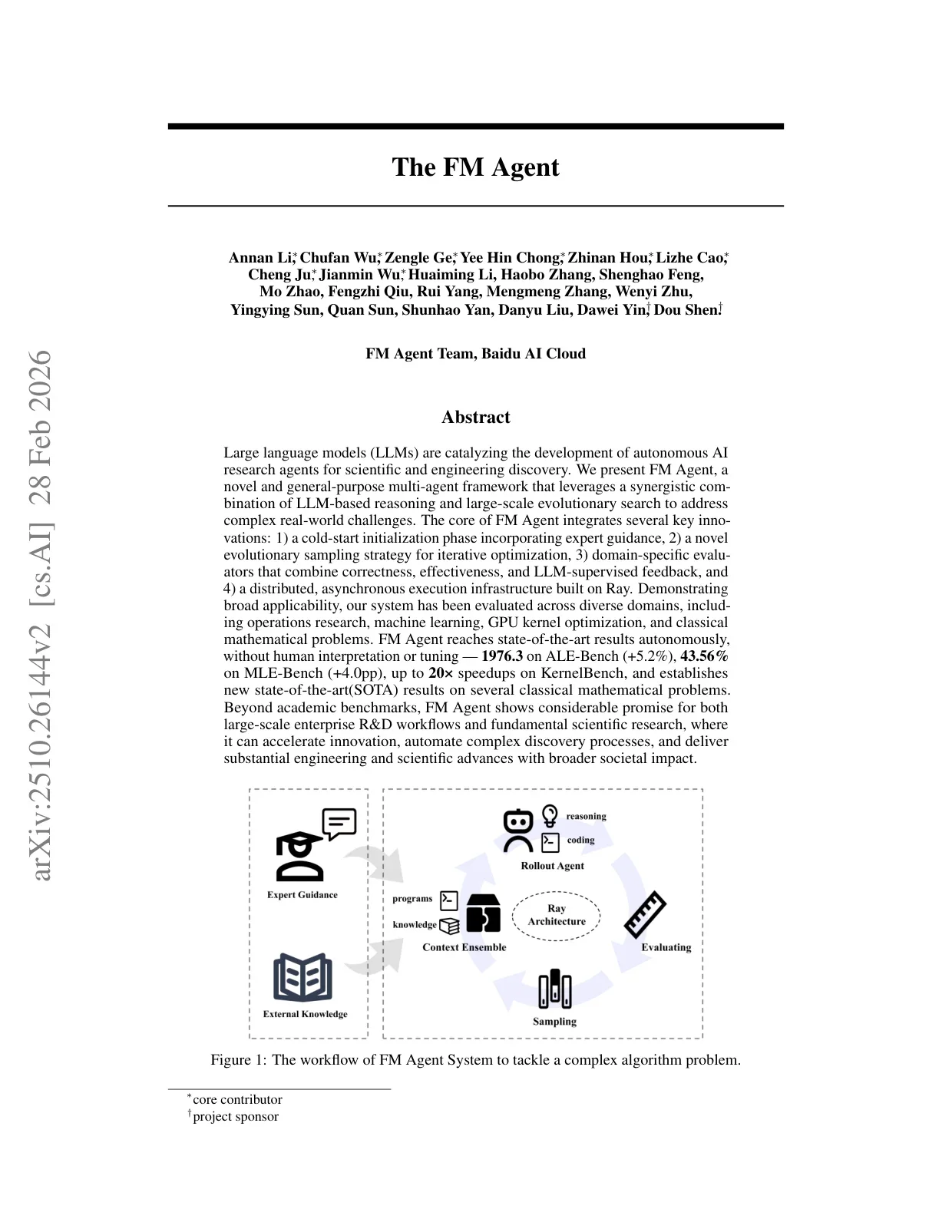
FM Agent combines LLM-driven mutation and crossover with a multi-island evolutionary architecture, cold-start population generation, domain-specific evaluators, and a Ray-based asynchronous infrastructure, achieving state-of-the-art results across MLE-Bench, ALE-Bench, KernelBench, and classical mathematics problems.
30 Oct 2025 · Paper
1. Motivation
Tree-search MLE agents (AIDE, ML-Master) commit to a single lineage of refinements and are vulnerable to premature convergence; flat evolutionary systems (FunSearch-style) generate diversity but lack a mechanism to allocate compute toward promising regions as the population evolves.123 FM Agent’s premise is that automated discovery needs both LLM reasoning (to generate semantically meaningful variations) and large-scale population parallelism with adaptive selection pressure (to explore divergent regions of the objective space without collapse). It is an industrial system - no code release - evaluated entirely on public benchmarks.1
2. Methodology
2.1 Search Structure
A two-stage architecture:1
Stage 1 Cold Start:
  Multi-Agent Parallel Expansion   -> broad initial population
  Proactive Solution Space Expansion -> cover divergent objective regions
  cluster solutions by max inter-island similarity
  #clusters = #islands; assign one cluster per island

Stage 2 Evolve:
  multi-population ISLAND MODEL
  islands evolve independently most of the time
  periodic inter-island interaction ("cross-pollination")
The island model means the search structure is a set of semi-isolated populations rather than one tree or one flat database - closer to AlphaEvolve’s island/database hybrid than to MCTS.14
2.2 State Representation
A population of programs (solution candidates) partitioned into islands; each island maintains an elite pool of top performers; population diversity is tracked with semantic and structural metrics, which feed the sampling controller (2.6).1
2.3 Generation Mechanism
LLM-driven mutation and crossover within island populations: the LLM acts as the variation operator, rewriting or recombining program candidates rather than sampling token-level noise. Two augmentations: (a) a RAG knowledge base whose fragments can be retrieved to inform variation operators; (b) optional human natural-language or code-level intervention steering variation (used only in case studies; benchmark runs are human-free).1
2.4 Evaluation & Grounding
A Domain-Specific Evaluator produces three feedback types: (a) a traditional single fitness score for quantitative ranking; (b) LLM-judge feedback for qualitative assessment; (c) domain-specific multi-dimensional metrics - numerical (e.g., balancing accuracy vs. latency) and contextual (e.g., resource utilization) for ML and CUDA-kernel tasks. The evaluator combines “functional correctness, operational effectiveness, and LLM-supervised quality assessment,” so executable correctness gates any fitness claim.1
2.5 Memory / Information Flow
Island-persistent populations act as lineage memory; the curated elite pool retains top solutions “to guide future generations”; the expert knowledge base with RAG retrieval supplies priors; periodic island migration shares genetic material across otherwise isolated lineages.1 Compared with ML-Master 2.0’s typed L1/L2/L3 caches, this memory is deliberately homogeneous - a design ML-Master 2.0 criticizes as treating knowledge as a single undifferentiated entity.15
2.6 Selection & Propagation
Selection is Adaptive Diversity-Driven Sampling: “a novel cluster-based sampling strategy … adaptively maintains a balance between exploration and exploitation by dynamically adjusting selective pressure according to real-time population diversity.”1 Concretely, candidates are sampled cluster-wise from the population (so no single dense region dominates reproduction), and compute is dynamically reallocated across islands - stronger lineages receive more evaluations while stagnating islands are starved. Propagation happens through elitism (top solutions persist in the elite pool) and periodic migration between islands. The single-task ablation (ALE-Bench ahc016, 5 runs) reports a final combined score of 0.7182, +10.99% vs. top- sampling and +58.26% vs. random, and surpasses random sampling’s maximum score at iteration 40 instead of 900.1
2.7 Anti-Slop / Anti-Hallucination Mechanisms
Correctness is gated by executable domain evaluators before fitness counts; the LLM judge is only one of three feedback channels, never the sole ground truth; headline benchmark runs are “performed exclusively by the LLM without human intervention” to keep claims clean; an expert-in-the-loop option exists only for real deployments and math case studies.1
Infrastructure: a Ray-orchestrated distributed cluster runs an asynchronous generation–evaluation pipeline with separate worker pools for program synthesis vs. evaluation, sustaining thousands of concurrent evolutionary processes.1
3. Results
- MLE-Bench (75 tasks, Gemini-2.5-Pro, 3 seeds): valid submission 96.89% ± 2.22, above median 51.56% ± 2.23, gold 22.67% ± 1.34, any medal 43.56% ± 1.78 - the best of its comparison table at publication. Baselines quoted from official reports (not re-run under matched conditions): AIDE (o1-preview) 16.9, ML-Master (DeepSeek-R1) 29.3, Neo 34.22, R&D-Agent (GPT-5) 35.11, InternAgent 36.44, Operand ensemble (GPT-5 with light multi-model assistance) 39.56.1267 First place among compared agents in 33/75 competitions and 9/15 on the hard split.1
- ALE-Bench (AtCoder heuristic contests): rating 1976.3, +5.2% over prior SOTA.1
- KernelBench: 2.08×–20.77× speedups over torch.compile.1
- Classical math problems: new SOTA on several (e.g., min max/min distance ratio point-packing), verified with AlphaEvolve’s verification code.14
- Ablations: each of cold start / adaptive sampling / island model contributes; the full method beats OpenEvolve with faster convergence and higher final scores.18
4. Limitations & Assumptions
- Industrial system with no code release; the Ray-cluster infrastructure implies a very large compute budget, so its numbers are not directly comparable to single-GPU academic agents (MARS’s Table 6 makes this resource disparity explicit for leaderboard agents generally).19
- The sampling ablation covers a single ALE-Bench task (ahc016).1
- The LLM-judge channel inherits judge-model biases; internal parameters (island count, migration period, fitness formulas, mutation prompts) are undisclosed.
- Math case studies used “high-level guidance inspired by human intuition,” blurring the full-autonomy claim even though benchmark numbers are human-free.1
5. Critical Analysis
- Distinctive strength: adaptive diversity-driven sampling with dynamic cross-island resource allocation - selection pressure is a controlled variable responding to measured population diversity, not a fixed schedule; combined with cold-start clustering, this directly attacks premature convergence at population scale.
- Structural weakness / trade-off: verifiability. With no released code, undisclosed internals, and infrastructure-scale compute, FM Agent’s results are an existence proof rather than a reproducible method; its homogeneous population memory also discards the typed experience→knowledge→wisdom distinctions that ML-Master 2.0 argues are necessary for long horizons.5
- Connections: sits in the FunSearch→AlphaEvolve evolutionary lineage (generate–score–evolve over programs, islanded populations) and beats the open-source OpenEvolve in its own ablation.348 Its related work names ML-Master’s MCTS-plus-memory design as the closest search-strategy refinement, and the two are directly comparable on MLE-Bench (43.56 vs. 29.3 any-medal).12 It credits R&D-Agent’s dual Researcher/Developer collaboration and periodic merging as the closest multi-agent design (35.11 vs. 43.56 any-medal).16 MARS later quotes FM Agent’s 43.6% leaderboard figure (misspelling it “Famou-Agent”) and surpasses it with MARS+ (62.7%) under two-tree parallel search.9
6. References
Footnotes
-
FM Agent Team (Baidu AI Cloud), 2025, “The FM Agent” - https://arxiv.org/abs/2510.26144 (full text: https://arxiv.org/html/2510.26144v1) ↩ ↩2 ↩3 ↩4 ↩5 ↩6 ↩7 ↩8 ↩9 ↩10 ↩11 ↩12 ↩13 ↩14 ↩15 ↩16 ↩17 ↩18 ↩19 ↩20 ↩21 ↩22 ↩23 ↩24
-
Liu et al., 2025, “ML-Master: Towards AI-for-AI via Integration of Exploration and Reasoning” - https://arxiv.org/abs/2506.16499 ↩ ↩2 ↩3
-
Romera-Paredes et al., 2024, “Mathematical discoveries from program search with large language models” (FunSearch), Nature - https://doi.org/10.1038/s41586-023-06924-6 ; code: https://github.com/google-deepmind/funsearch ↩ ↩2
-
Novikov et al., 2025, “AlphaEvolve: A coding agent for scientific and algorithmic discovery” - https://arxiv.org/abs/2506.13131 ↩ ↩2 ↩3
-
Zhu et al., 2026, “Toward Ultra-Long-Horizon Agentic Science: Cognitive Accumulation for Machine Learning Engineering” (ML-Master 2.0) - https://arxiv.org/abs/2601.10402 ↩ ↩2
-
Yang et al., 2025, “R&D-Agent” - https://arxiv.org/abs/2505.14738 ↩ ↩2
-
Chan et al., 2024, “MLE-Bench” - https://arxiv.org/abs/2410.07095 ; https://github.com/openai/mle-bench ↩
-
Sharma, 2025, OpenEvolve (open-source evolutionary coding agent; FM Agent ablation baseline) - https://github.com/codelion/openevolve ↩ ↩2
-
Chen et al., 2026, “MARS: Modular Agent with Reflective Search for Automated AI Research” - https://arxiv.org/abs/2602.02660 ↩ ↩2