
R&D-Agent: Automating Data-Driven AI Solution Building Through LLM-Powered Research, Development, and Evolution
R&D-Agent splits machine learning engineering between a Researcher agent that converts performance feedback into ideas and a Developer agent that converts error feedback into code, runs multiple heterogeneous exploration traces in parallel, and fuses their partial results into composite solutions; v2 generalizes this into a two-phase, six-component formalization of the whole MLE workflow.
20 May 2025 · Paper
1. Motivation
Prior MLE agents conflate two different feedback loops: deciding what to try next (driven by performance feedback) and making the code work (driven by error feedback). AIDE-style single-tree agents entangle both in one coding prompt, and single-lineage search wastes compute on dead ends.12 R&D-Agent’s v1 claim is that role specialization plus parallel exploration traces that exchange information and fuse beats monolithic search; v2’s broader claim is that the entire MLE workflow can be decomposed into two phases and six components, “turning agent design for MLE from ad-hoc craftsmanship into a principled, testable process.”13
2. Methodology
2.1 Search Structure
v1: parallel multi-trace exploration. Independent traces run with heterogeneous configurations (prompt strategies, model backends, tools, heuristics, knowledge scopes); traces support checkpoint-forking (“launch a new exploration trace from an existing checkpoint”) and cross-trace merge, so the global structure is a set of interacting lineages rather than a single tree. v2: multi-trace becomes one design point in a structured space - the component FC-Exploration Path Structuring spans chain-based (greedy, e.g., MLE-STAR), tree-based (e.g., ML-Master), and hybrid/adaptive organizations.134
2.2 State Representation
A trace is a sequence of (idea → code → evaluation) iterations with a maintained performance profile (solution quality, novelty, resource cost, error resilience); a knowledge base accumulates experience; checkpoints are the fork/merge units.1
2.3 Generation Mechanism
Role-specialized generation. The Researcher proposes natural-language high-level ideas (hypotheses); the Developer implements them in two phases: (1) iteratively debug a runnable solution on a sampled subset of the data - mimicking cheap human prototyping - then (2) run on the full dataset for performance.1 Role-fit model routing exploits model asymmetries (“models like o1 are very good at reasoning and coming up with creative ideas, while models like GPT-4.1 are excellent at following instructions”); the evaluated configuration is o3 as Researcher + GPT-4.1 as Developer.1
2.4 Evaluation & Grounding
The Developer runs code on the full data for the validation metric. The final submission among all valid candidates (individual traces + fused) is chosen by a composite scoring function considering validation performance, solution robustness, and overfitting risk, derived from score curves and model diagnostics.1 v2 names this design axis FC-Evaluation Strategy (“obtaining reliable and robust data-driven feedback”).3
2.5 Memory / Information Flow
A knowledge base accumulates practice-derived lessons for the Researcher. A cross-trace information exchange protocol gives a new trace the earlier trace’s exploration history and failure cases “to avoid repeating ineffective strategies.” A centralized module tracks per-trace profiles and can terminate unproductive traces, spawn new ones with modified configs, or initiate trace fusion.1 v2 formalizes this as FC-Memory Context (storage/retrieval/reuse of historical solutions, evaluation results, insights).3
2.6 Selection & Propagation
Selection operates at two levels: a scheduler decides which traces live, die, or fork (2.5), and Multi-Trace Merge performs compositional fusion at multiple granularities: features from trace A + model architecture from trace B + post-processing from trace C. Components are scored on utility, novelty, compatibility, and performance impact; the fusion strategy is configurable (greedy selection, weighted voting, optimization-guided fusion); rules for early-stop/spawn, exchange payload, and fusion timing are user-customizable. The reported schedule: two traces × 11 h, then a 2-hour fusion phase, then iteration on the fused solution to the 24-h cap.1
v2’s six Framework Concepts (verbatim labels): Research phase - FC-Planning (dynamic timing/budget/guidelines, exploration–exploitation management), FC-Exploration Path Structuring, FC-Reasoning Pipeline (dataset analysis, hypothesis formulation, benefit justification, trade-off assessment, solution sketches), FC-Memory Context; Development phase - FC-Coding Workflow (modular design, iterative debugging, rapid prototyping on sampled data), FC-Evaluation Strategy.3
2.7 Anti-Slop / Anti-Hallucination Mechanisms
Error-driven debugging grounded in real execution tracebacks; sampled-data prototyping that catches runtime failures cheaply before full runs; composite submission scoring that explicitly penalizes overfitting risk; failure-case sharing that prevents traces from repeating dead ends.1 v2’s six-component decomposition is itself presented as a testability/verifiability instrument: each component can be evaluated in isolation.3
3. Results
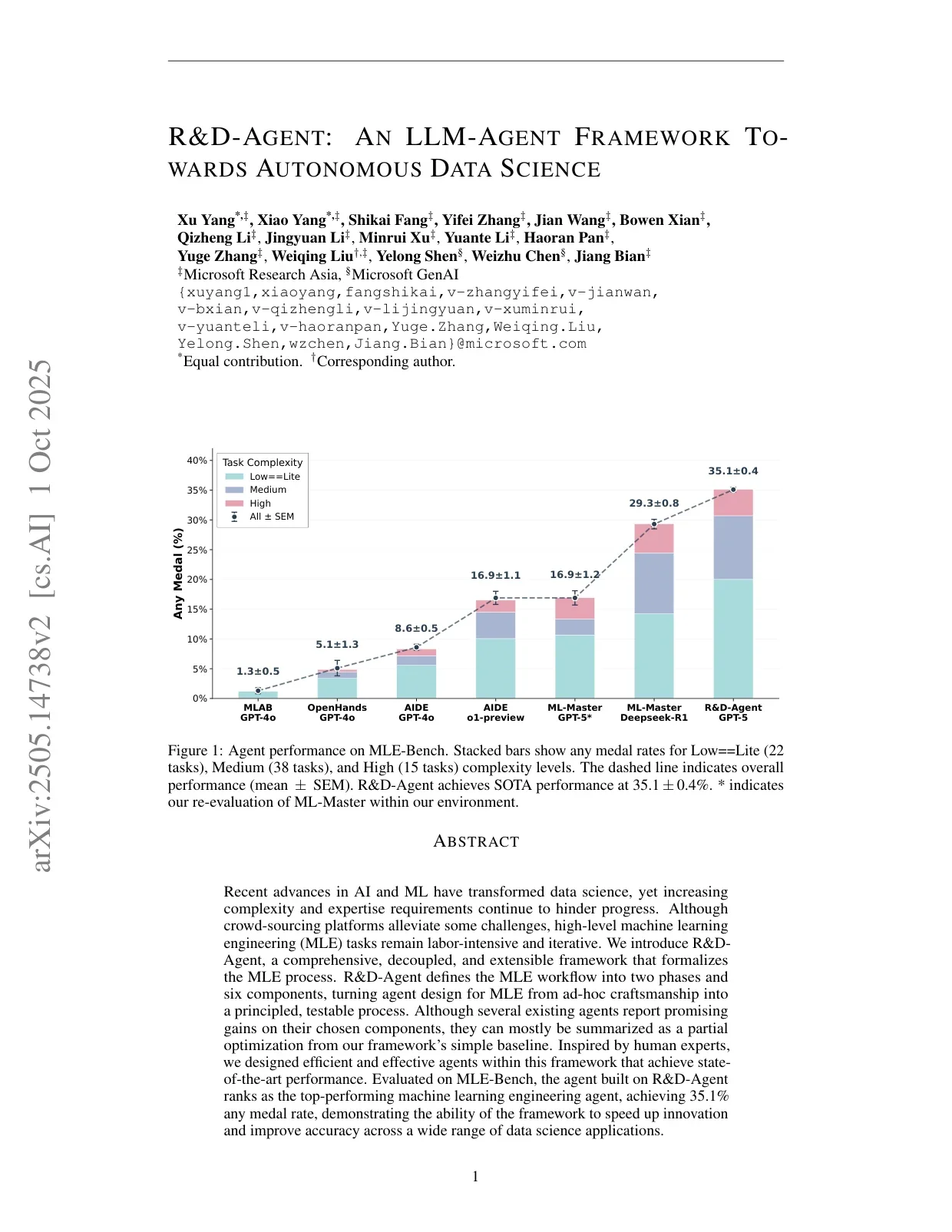
v1 MLE-Bench (any-medal %; Low/Medium/High/All; 24 h; 12 vCPUs, 220 GB RAM, 1×V100; 5–6 seeds):1
| Configuration | Low | Medium | High | All |
|---|---|---|---|---|
| AIDE (o1-preview) | 34.3 | 8.8 | 10.0 | 16.9 |
| R&D-Agent (o1-preview both roles) | 48.18 | 8.95 | 18.67 | 22.4 |
| R&D-Agent o3(R) + GPT-4.1(D) | 51.52 | 7.89 | 16.67 | 22.45 |
| R&D-Agent o3(R) + GPT-4.1(D), multi-trace | 50.54 | 9.86 | 20.00 | 24.00 |
v2 claim: 35.1% any-medal on MLE-Bench with GPT-5 (leaderboard entry 2025-09-26: 68.18 low / 21.05 medium / 22.22 high / 35.11 ± 0.44 all, 12-h runtime), described at submission as “the top-performing machine learning engineering agent”; the OpenReview version adds a re-evaluation of ML-Master in Microsoft’s own environment.35 Leaderboard history: 22.40% (o1-preview, May 2025) → 30.22% (o3 + GPT-4.1, Aug 2025) → 35.11% (GPT-5, Sept 2025).5 These are self-reported leaderboard submissions; baselines were not re-run under matched conditions in v1.
4. Limitations & Assumptions
- v1 is a self-described “short technical report … selected key results”; ablations on early-stop policies, knowledge injection, and adaptive fusion timing were explicitly deferred (“currently under development”).1
- The multi-trace gain over single-trace is modest (24.00 vs. 22.45 All-split) and within noise - the fusion mechanism’s value is not cleanly isolated.1
- v2’s “top-performing” claim is time-stamped (September 2025); it was later surpassed by FM Agent (43.56), ML-Master 2.0 (56.44), and MARS+ (62.7).67
- The leaderboard transparency columns flag external-knowledge usage as “Yes.”5
- Whether the six-component framework is prescriptive or a post-hoc taxonomy of existing agents remains debatable.
5. Critical Analysis
- Distinctive strength: the explicit Researcher/Developer role split by feedback type - performance feedback drives idea generation, error feedback drives code refinement - combined with compositional trace fusion that merges partial results (features, architecture, post-processing) rather than picking a winner.
- Structural weakness / trade-off: coordination overhead and configurability without guidance: the exchange payload, fusion timing, and early-stop rules are user-customizable knobs whose ablations were deferred, and the measured multi-trace benefit is small relative to its complexity.
- Connections: v1’s explicit baseline is AIDE, “the previous public best performer,” beaten under the same o1-preview backend (22.4 vs. 16.9 any-medal).12 v2’s taxonomy maps ML-Master as covering mainly “exploration path structure via tree-based search,” while ML-Master reciprocally uses R&D-Agent (22.4%) as its strongest baseline.34 FM Agent cites R&D-Agent’s dual-agent collaboration with periodic merging as the closest multi-agent design, and MARS uses R&D-Agent (GPT-5, 35.1%) as a leaderboard comparator.67
6. References
Footnotes
-
Yang et al., 2025, “R&D-Agent: Automating Data-Driven AI Solution Building Through LLM-Powered Automated Research, Development, and Evolution” - https://arxiv.org/abs/2505.14738 (v1 full text: https://arxiv.org/html/2505.14738v1) ↩ ↩2 ↩3 ↩4 ↩5 ↩6 ↩7 ↩8 ↩9 ↩10 ↩11 ↩12 ↩13 ↩14
-
Jiang et al., 2025, “AIDE: AI-Driven Exploration in the Space of Code” - https://arxiv.org/abs/2502.13138 ↩ ↩2
-
Yang et al., 2025, “R&D-Agent: An LLM-Agent Framework Towards Autonomous Data Science” (v2 manuscript, six-component framework) - https://openreview.net/pdf?id=APjCXYORXO ↩ ↩2 ↩3 ↩4 ↩5 ↩6 ↩7 ↩8
-
Liu et al., 2025, “ML-Master: Towards AI-for-AI via Integration of Exploration and Reasoning” - https://arxiv.org/abs/2506.16499 ↩ ↩2
-
MLE-Bench leaderboard results (incl. R&D-Agent entries) - https://github.com/openai/mle-bench/issues/138 ; https://github.com/openai/mle-bench ↩ ↩2 ↩3
-
FM Agent Team (Baidu AI Cloud), 2025, “The FM Agent” - https://arxiv.org/abs/2510.26144 ↩ ↩2
-
Chen et al., 2026, “MARS: Modular Agent with Reflective Search for Automated AI Research” - https://arxiv.org/abs/2602.02660 ↩ ↩2