
Illuminating Search Spaces by Mapping Elites (MAP-Elites)
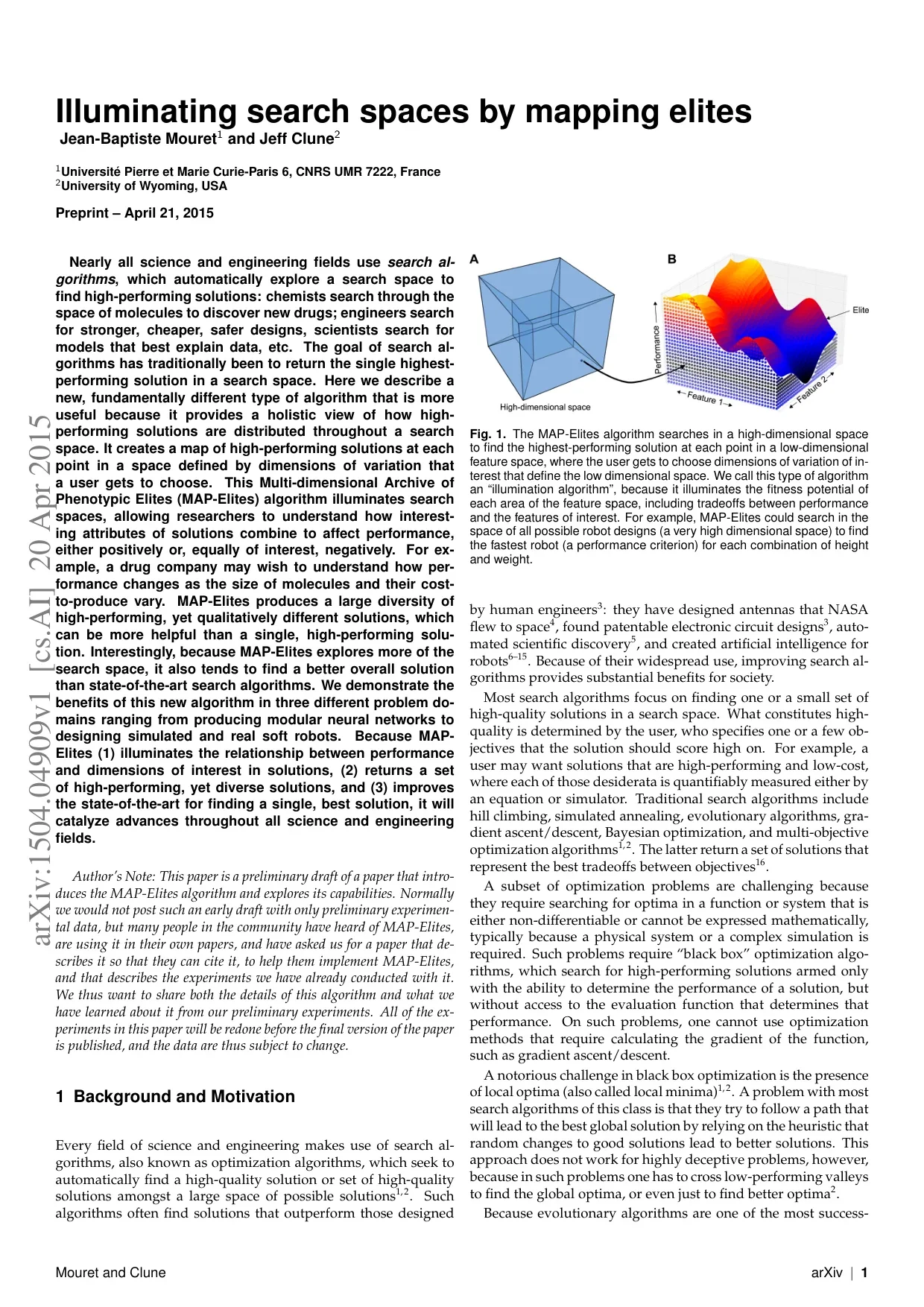
MAP-Elites maintains a discretized archive over user-chosen feature dimensions and keeps the best-performing solution found so far in each cell, thereby illuminating the fitness potential of the whole feature space - and, by exploring more, often finding a better overall solution than optimization-focused search.
2015 · Paper
1. Motivation
Evolutionary algorithms return one best solution and discard the search history that produced it. Yet in deceptive landscapes - where short-term fitness gains lead away from the global optimum - single-lineage optimization stalls, and practitioners actually want repertoires: many high-performing solutions that differ along dimensions the user cares about (a robot’s height vs. weight vs. energy use; a molecule’s size vs. cost).1 MAP-Elites reframes the goal from optimization to illumination: reveal the relationship between user-defined features and achievable performance across the entire space. “Any illumination algorithm can also be used as an optimization algorithm, making illumination algorithms a superset of optimization algorithms.”1 This archive-of-elites idea became the foundational quality-diversity (QD) mechanism that later LLM-driven search systems - Promptbreeder, FunSearch, and explicitly AlphaEvolve - reuse as their diversity engine.23
2. Methodology
2.1 Search Structure
A steady-state loop over iterations:
init: place G random genomes into cells (keep best per cell)
for I iterations:
    x  = pick an elite uniformly at random from occupied cells
    x' = mutate and/or crossover(x)
    p' = performance(x'); b' = feature_descriptor(x')
    if cell(b') is empty or P(cell(b')) < p':
        cell(b') ← (x', p')          # per-cell elitist replacement
The algorithm is embarrassingly parallel (batch evaluation on clusters) and admits a hierarchical variant in which coarse cells subdivide after predetermined evaluation counts.1
2.2 State Representation
Three spaces are explicitly distinguished: (i) the search space of genomes (direct or indirect/generative encodings allowed); (ii) the phenotype ; (iii) an -dimensional, user-defined feature space - the behavior descriptor (e.g., robot height/weight/energy) - discretized into cells.1 The archive is the entire population: “one can consider the archive… as the traditional population in an evolutionary algorithm. The difference is that in MAP-Elites each member of the population is by definition diverse.”1
2.3 Generation Mechanism
After initializing with random genomes, every candidate derives from an archive elite by random variation. The crucial design choice: the parent is selected uniformly at random over occupied cells, not fitness-proportionately - selection pressure is spread across niches rather than concentrated on the global best, which is precisely what prevents collapse onto one deceptive peak.1
2.4 Evaluation & Grounding
Each candidate is scored by a fitness function and a feature-descriptor function measured on the phenotype “either in simulation or reality.”1 Three domains instantiate this: (i) modular neural networks on the 8-pixel retina task (fitness = % correct over 256 patterns; features = connection cost × modularity; 512×512 map, 10,000 evaluations); (ii) simulated soft-robot morphologies; (iii) a real soft robotic arm evaluated directly on hardware (1-D feature = end-effector x-position, 64 cells; fitness = y-height; 640 evaluations vs 729 for grid search).1
2.5 Memory / Information Flow
The archive is the long-term memory: elites persist until displaced by a strictly better occupant of the same cell; there is no cross-cell forgetting and no sliding window (contrast Reflexion’s buffer).14 Lineage analysis shows information flows laterally through the map: most elites descend from nearby or mid-distance neighbors (stepping-stone dynamics), and elite lineages “frequently traverse long paths through many different regions of the map” - diversity in memory is what enables jumps across fitness valleys.1
2.6 Selection & Propagation
Two rules define the system. Replacement: an offspring displaces the incumbent iff the cell is empty or the incumbent’s performance is lower - verbatim from the Fig. 2 pseudocode: if P(b′) = ∅ or P(b′) < p′ then store x′ in the map according to b′.1 This per-cell elitism guarantees monotonically improving illumination. Parent selection: uniform over current elites. Termination: time budget, evaluation budget, or an archive property (e.g., fraction of cells filled).1
2.7 Anti-Slop / Anti-Hallucination Mechanisms
Reading “slop” as the premature-convergence/deception pathology, the mechanism itself is the control: mandatory per-cell diversity prevents population collapse, and per-cell replacement requires strictly better evaluated performance, so no unverified candidate ever enters memory. For honest cross-algorithm comparison the paper proposes four illumination metrics - global performance, global reliability, precision (“opt-in reliability”), and coverage - and runs controlled experiments against a traditional EA, Novelty Search with Local Competition, random sampling, and grid search, with 20 replicates (retina) / 10 replicates (robot arm) and significance at on all four criteria.1
3. Results
- Retina neural networks: MAP-Elites significantly outperforms the traditional EA, NS+LC, and random sampling on all four metrics at equal evaluation budgets (, 20 runs each); exact bar values are figure-only. Strikingly, it also finds a better single best solution than the optimization-only EA - “likely because the retina problem is deceptive and this traditional evolutionary algorithm has no pressure for diversity.”1
- Simulated soft robots: the illuminated maps expose morphology↔performance tradeoffs, and per-cell elites outperform separately searching each cell (via the Nguyen et al. 2015 follow-up).1
- Real soft robot arm: MAP-Elites matches grid search and random sampling on easy regions (–) and beats both on the hard intermediate region (–), using 640 evaluations vs grid search’s 729.1
- The peer-reviewed application, Cully et al. (Nature 2015), used the same archive-of-behaviors principle to let a damaged robot adapt in under two minutes.5
4. Limitations & Assumptions
The feature space must be user-defined and fixed upfront: the algorithm “does not allow the addition of new types of cells over time… It thus, by definition, cannot exhibit open-ended evolution.”1 Cells may be unfillable (no genome maps there) or simply unfound - coverage is never guaranteed.1 Archive size grows exponentially with feature-space dimension (the curse of dimensionality later addressed by CVT-MAP-Elites).6 The arXiv report is a self-declared preliminary draft whose experiments “will be redone before the final version”; the MOLE comparison is anecdotal at matched resolutions.1
5. Critical Analysis
- Distinctive strength: one replacement rule converts any evolutionary search into an illumination algorithm, and the paper demonstrates the counterintuitive payoff - diversity maintenance as a means to better optimization, not just nicer maps - with hardware-grounded evidence and formal illumination metrics.1
- Structural weakness / trade-off: the user must know, in advance, which behavior dimensions matter and how to discretize them; a poorly chosen descriptor wastes the entire evaluation budget illuminating an irrelevant projection, and grid memory scales badly beyond a few dimensions.16
- Connections: AlphaEvolve’s evolutionary database is verbatim “inspired by a combination of the MAP elites algorithm and island-based population models,” making MAP-Elites its most direct archival ancestor;3 FunSearch’s islands with score-favoring sampling are a diversity-preserving archive in the same QD lineage;2 and Promptbreeder explicitly cites the QD/MAP-Elites literature as the inspiration for its embedding-based diversity filtering,7 while LLM-SR’s score-signature clustering within islands is a lightweight echo of per-niche archiving.8
6. References
Footnotes
-
Mouret & Clune, Illuminating Search Spaces by Mapping Elites (PDF v1): https://arxiv.org/pdf/1504.04909.pdf ↩ ↩2 ↩3 ↩4 ↩5 ↩6 ↩7 ↩8 ↩9 ↩10 ↩11 ↩12 ↩13 ↩14 ↩15 ↩16 ↩17 ↩18 ↩19 ↩20 ↩21
-
Romera-Paredes et al., FunSearch, Nature 625:468–475: https://www.nature.com/articles/s41586-023-06924-6 ↩ ↩2
-
Novikov et al., AlphaEvolve (whitepaper): https://arxiv.org/abs/2506.13131 ↩ ↩2
-
Shinn et al., Reflexion, NeurIPS 2023: https://arxiv.org/abs/2303.11366 ↩
-
Cully et al., Robots that can adapt like animals, Nature 521:503–507 (2015): https://www.nature.com/articles/nature14422 ↩
-
Vassiliades et al., CVT-MAP-Elites: https://arxiv.org/abs/1610.05729 ↩ ↩2
-
Fernando et al., Promptbreeder: https://arxiv.org/abs/2309.16797 ↩
-
Shojaee et al., LLM-SR, ICLR 2025: https://arxiv.org/abs/2404.18400 ↩